The whole integrity workflow, on one platform.
PIMARIS carries inspection data through assessment, risk and prioritisation to executed field repairs — one connected spine, no silos, no re-keying.
Not a drawer of point tools — one connected workflow
Most operators stitch integrity together from a vendor PDF, an engineer’s spreadsheet, a separate FFS tool and a work-order system. PIMARIS replaces that chain with one platform.
Import
Ingest any vendor’s ILI tally and normalise it to one schema.
Align
Match features across runs years apart, correcting tool stretch.
Assess
Run fitness-for-service across methods, with a growth-rate floor.
Prioritise
Rank every defect into a dig list by ERF and remaining life.
Repair
Raise work orders, run the crew, close out with field reports.
From a vendor’s raw file to an engineering result
The technical heart of PIMARIS: turning inconsistent inspection data into a clear, consistent assessment.
Multi-vendor ILI import
Every ILI vendor delivers a different tally. PIMARIS ingests the raw file and walks it through guided standardisation to one canonical schema. Vendor profiles remember a format so the next run imports in a click.
Run-to-run alignment
PIMARIS aligns runs through a four-stage engine, then computes per-feature corrosion growth with a statistical floor — so a noisy measurement can’t understate remaining life.
The fitness-for-service suite
For every metal-loss defect, PIMARIS runs the standard assessment methods side by side. The calculation core is a pure, stateless engine — the same result for one defect or thousands.
- ASME B31G original & Modified B31G (0.85dL)
- DNV-RP-F101 — single and interacting / colony defects
- RSTRENG / Effective Area river-bottom profile
- API 579-1 metal loss, Levels 1 & 2
- PRCI MAT-8 crack-like flaw assessment
- Dent strain screening · Monte Carlo uncertainty
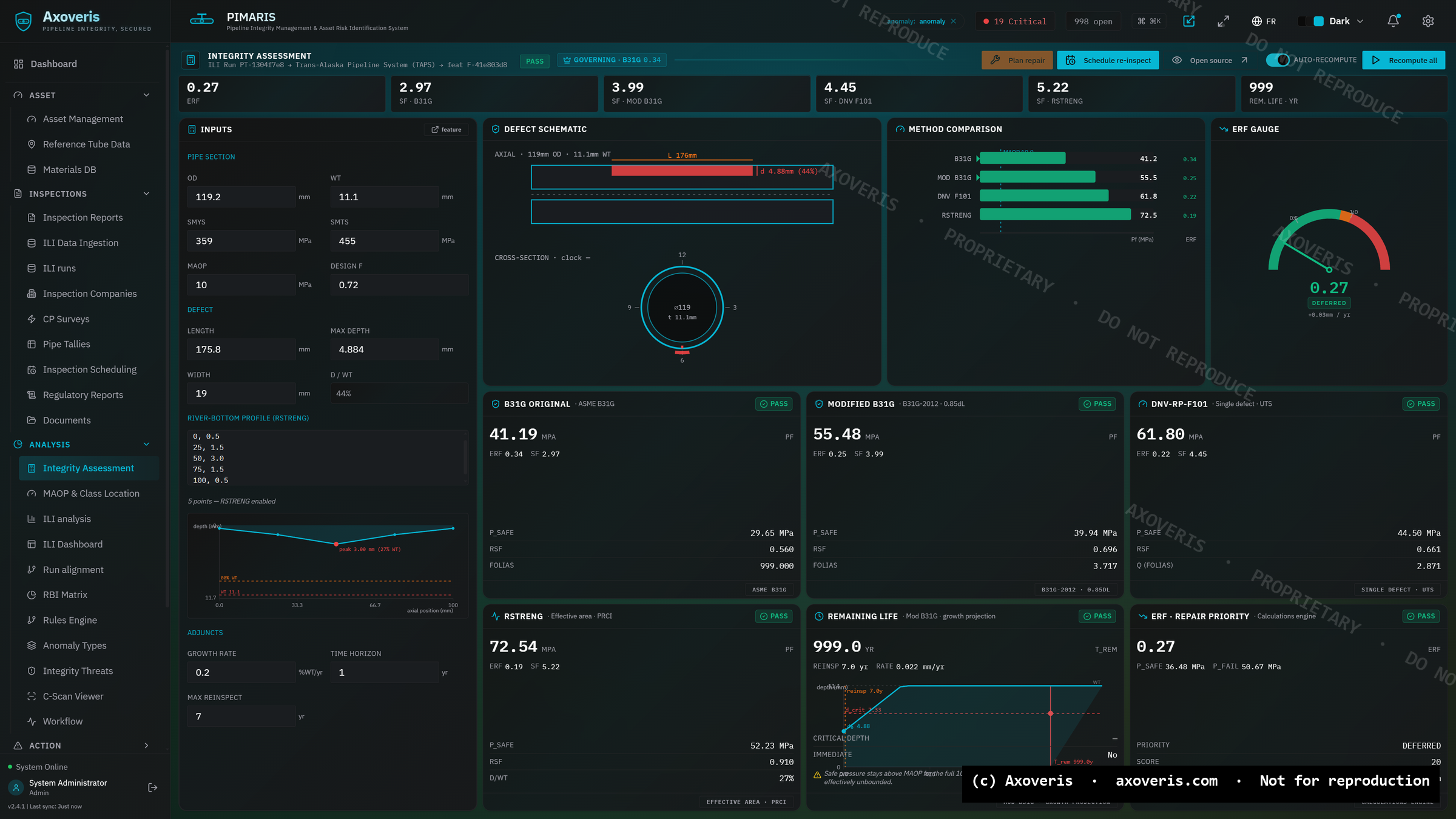
Built on the codes: PIMARIS calculations follow the worked examples in the ASME B31G, DNV-RP-F101 and PRCI PR-3-805 appendices — a test corpus every release keeps green.
Results become a plan, and the plan gets executed
Dig list, work orders, close-out
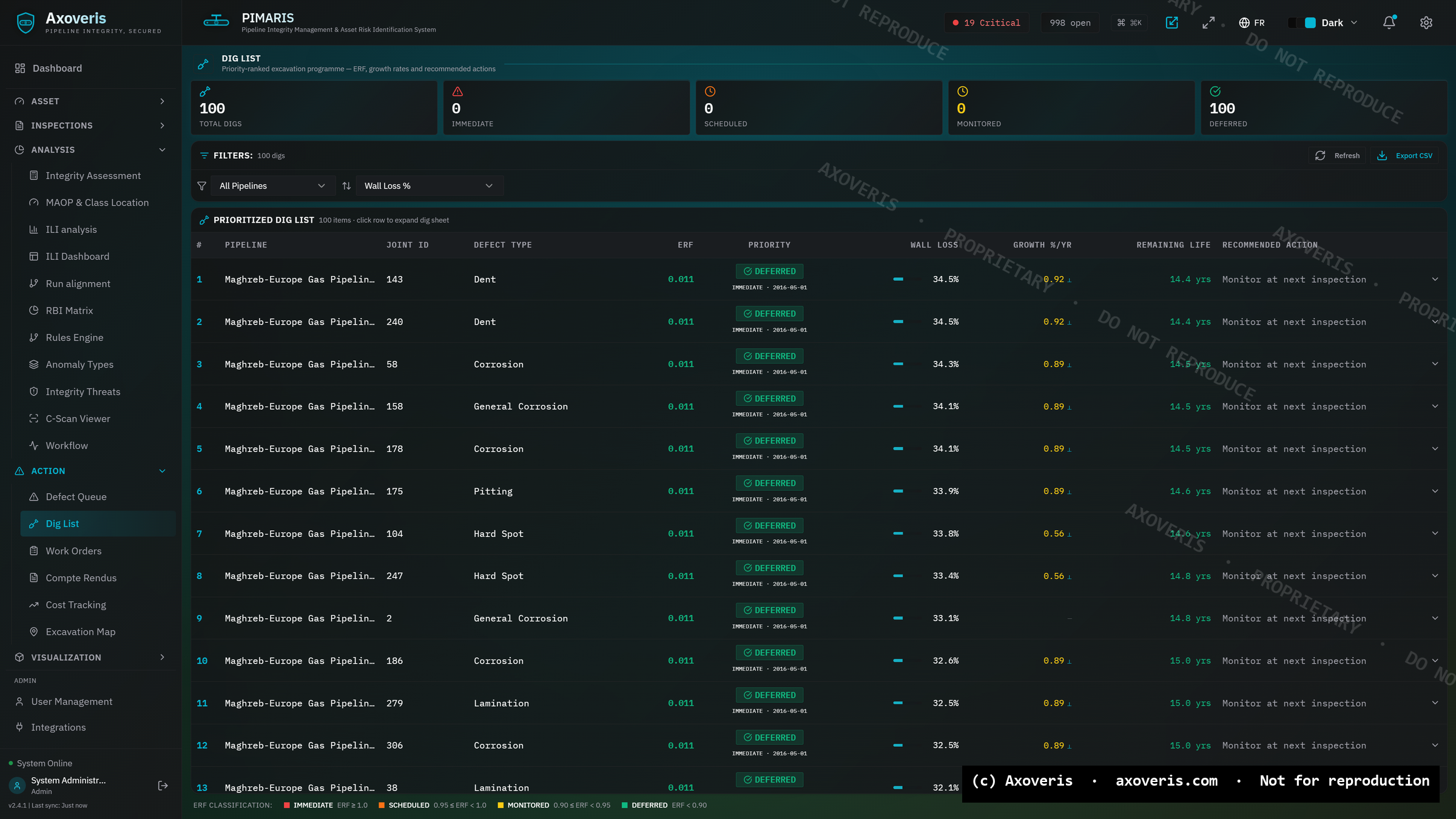
The dig list is where analysis becomes a plan: PIMARIS computes ERF and remaining life for every defect and ranks them — Immediate, Scheduled, Monitored, Deferred. Raise a work order from a defect; the field crew closes out with an excavation report.
- Auto-generated, sortable, filterable dig list
- Work-order lifecycle: approve → start → complete
- Field excavation reports and cost tracking
- Re-inspection scheduling on a clear interval
Risk, rules and visualisation
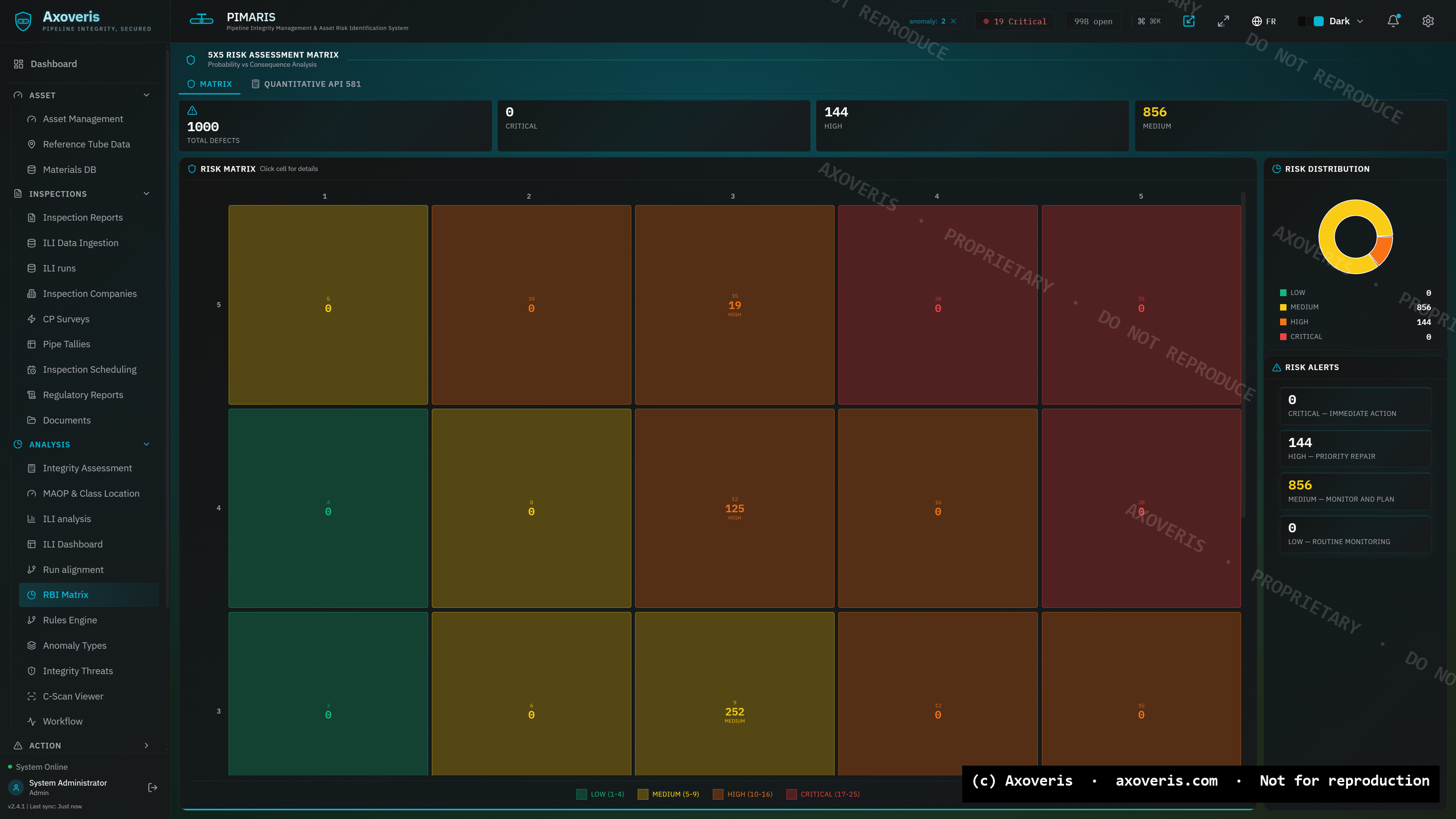
Around the spine sit the always-on domains — RBI, a visual rules engine, and a 3D pipeline viewer that colours the wall by metal loss.
- RBI matrix — API 580 / 581
- Drag-and-drop rules engine for house policy
- 3D pipeline viewer with wall-loss heatmap
- C-Scan wall-thickness grids & geospatial maps
What a procurement and IT reviewer will ask about
Authentication & access
Short-lived access tokens, an HttpOnly refresh cookie, password hashing and role-based access across admin, editor and viewer.
A transparent record
Every computed value shows its inputs and formula version, and every change is written to an immutable, hash-chained log.
Sovereign deployment
A tenant boundary threaded through every record. Deploy on sovereign infrastructure, on-premise, or in the cloud.
Aligned with the standards your programme runs on
A modern, boring-in-a-good-way stack
Async Python on FastAPI, a React front end and MongoDB. The backend is a set of per-domain services; the calculation core touches no database.
Follow the spine with our team
From the alignment engine to the FFS suite and the dig list — see PIMARIS run end to end.